





Statement by His Excellency President Cyril Ramaphosa during the session on Shaping the Future for Inclusive Global Growth, 18th BRICS Leaders' Summit BRICS Partners and Outreach, New Delhi, India
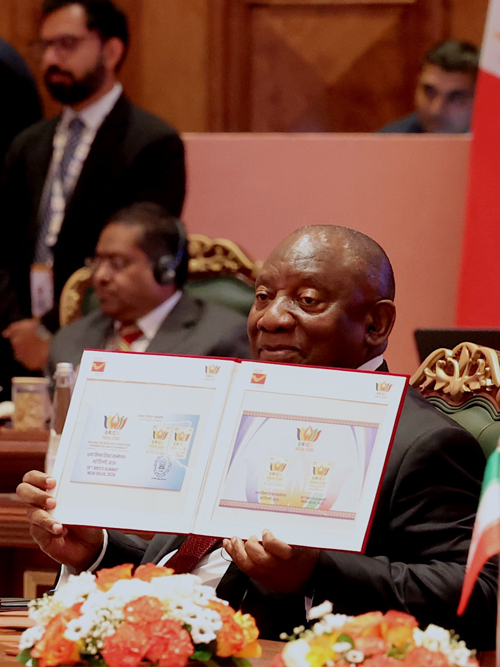
Your Excellency Prime Minister Narendra Modi,
Your Excellencies, Heads of State and Government,
Representatives of BRICS Partner Countries,
Distinguished guests,
Ladies and gentlemen,
The 20th anniversary of BRICS is a moment to reaffirm our commitment to deeper cooperation and a more ambitious agenda – ranging from science, technology and innovation to sustainable development and economic transformation.
We live in a rapidly changing world that contains both risks and opportunities.
The achievement of inclusive growth requires that we address persistent global challenges such as poverty and inequality, while responding to the devastating effects of climate change and the rapid advances in artificial intelligence.
The increasing frequency and intensity of climate-related disasters threaten to reverse hard-won development gains and deepen inequality.
Resilience is therefore essential for inclusive growth and human development.
We commend India for prioritising resilience, which links directly to the Disaster Risk Reduction outcomes of South Africa’s G20 Presidency.
We must integrate disaster risk reduction into macroeconomic policy, climate financing and sustainable infrastructure.
Vulnerable countries must have equitable access to the technologies, finance and capacity to withstand future shocks.
The global energy transition must prioritise re-skilling, protecting livelihoods and anchoring new industries that generate quality jobs.
It is important that markets for critical minerals and transition technologies are built on transparency, and that value chains are diversified and responsible.
To ensure inclusive growth in Africa and other regions of the world, beneficiation of minerals must take place at source.
The capabilities of artificial intelligence models are becoming increasingly more powerful and are rapidly reshaping almost every area of economic and social life.
Artificial intelligence and associated technologies have the potential to usher in a new era of productivity and human progress.
If used effectively and responsibly, artificial intelligence can support our efforts to reduce inequality, poverty and underdevelopment.
It is showing that it has the capability to transform medicine, education, scientific discovery, agriculture, productivity and development.
But we must listen carefully to what those who are developing the most powerful AI systems are themselves telling us.
They are warning about systems capable of advanced cyber operations, assistance in biological weapons development, autonomous action, manipulation, mass surveillance, disruption of employment and, ultimately, systems whose capabilities may become difficult for human beings to control.
We should therefore neither fear AI nor approach it recklessly.
Our responsibility is to ensure that human governance advances as rapidly as artificial intelligence itself.
We agree with those in the industry, such as Dario Amodei, the CEO of Anthropic, who are arguing that AI companies should be subject to formal external checks, audits and government authority.
Such oversight is standard practice in other industries whose activities have a significant impact on human safety and well-being, such as aviation, pharmaceuticals, nuclear power and financial institutions.
We must never reach a situation where technological capability has moved beyond our capacity to understand it, supervise it and control it.
South Africa accordingly proposes that BRICS should establish an international mechanism for the independent scientific evaluation of AI.
This should be backed by meaningful human-control principles, mandatory reporting of serious incidents, progressively stronger safeguards as capability increases, and simultaneous investment in sovereign AI capacity for developing economy countries.
We support continued scientific cooperation in initiatives such as the BRICS Intelligent Telescope and Data Network and the BRICS Vaccine Research and Development Centre.
We must strengthen medical sovereignty, vaccine development, genomic surveillance and diagnostic capabilities for the Global South.
We must work together to transform agriculture through innovation.
Economic and financial cooperation is at the centre of the resilience we seek.
South Africa supports a balanced and gradual expansion of the New Development Bank.
We welcome continued discussion of the proposed New Investment Platform and the BRICS Multilateral Guarantees initiative.
BRICS must press ahead with greater use of local currencies, stronger cross-border payment systems and deeper financial interconnectivity.
As BRICS enters its third decade, it should be more ambitious.
Our engagement with Partner Countries should spur deeper cooperation, particularly in public health, education, science and technology, finance and trade.
In the 40th anniversary year of the UN Resolution on the Right to Development, we call on BRICS to renew its commitment to the realisation of the inalienable human right to development.
I wish to conclude with a rallying call by Indian poet, activist and leader, Ms Sarojini Naidu, who said:
“We want deeper sincerity of motive, a greater courage in speech and earnestness in action.”
I thank you.
.png)

.png)

