


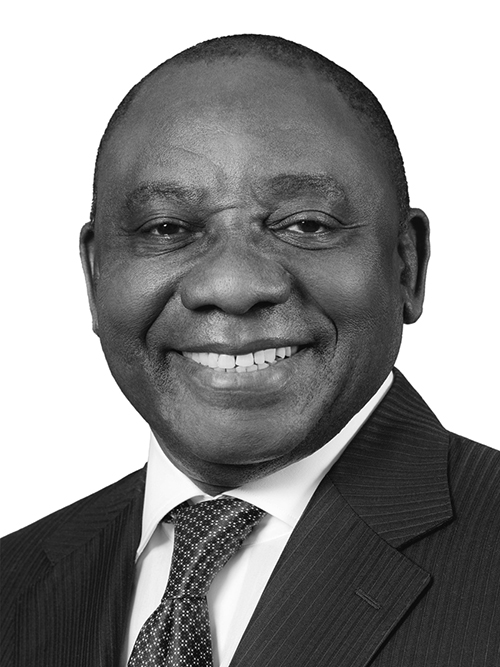
Address delivered on behalf of President Cyril Ramaphosa by Minister Kgosientsho Ramokgopa at the African Green Hydrogen Summit 2026, Century City Conference Centre, Cape Town
Programme Director,
Minister of Electricity and Energy, Dr Kgosientsho Ramokgopa,
Minister of Trade, Industry and Competition, Mr Parks Tau,
Ministers and Deputy Ministers,
Acting Premier of the Western Cape, Mr Tertuis Simmers,
Members of the diplomatic corps,
Representatives of development finance institutions and development agencies,
Representatives of business, labour, civil society and academia,
Distinguished guests,
Ladies and gentlemen,
Good morning.
It is a pleasure to address this premier event on expanding the frontiers of the green hydrogen economy in Africa.
I am sorry that I am unable to attend in person, but am grateful for this opportunity to participate virtually.
This Summit showcases innovation, investment and collaboration in a sector that is set to change the trajectory of industrial development.
With abundant renewable energy and water resources and vast reserves of critical minerals, Africa is positioned to become a major global hub for this burgeoning industry.
Energy technologies and critical minerals have become important features of global relations.
I have just returned from the 18th BRICS Summit in New Delhi, which recognised the foundational role of energy security in social and economic development.
The BRICS leaders agreed to cooperate on zero- and low-emissions hydrogen and its value chains.
As African nations, we are keenly aware that we must significantly accelerate our efforts if we are to be at the forefront of opportunity.
This is a once-in-a-generation opportunity for Africa to be at the forefront of transformational industrial development.
Green hydrogen sits at the intersection of two of the defining imperatives of our time: firstly, to strengthen energy resilience and security, and, secondly, to grow inclusive, low-carbon economies.
Both imperatives are fundamental to human development.
There are less than four years to the 2030 deadline for the Sustainable Development Goals.
That means there are less than four years in which we need to make sufficient progress towards the realisation of Sustainable Development Goal 7 on affordable, reliable and modern energy for all.
Growing the green hydrogen economy is therefore about far more than investment and a foothold in an emerging industry.
It is about materially improving the lives of millions of Africans who continue to experience energy poverty.
By expanding access to affordable energy and creating jobs across the value chain, we give true meaning to a just energy transition.
That is why we need to move with speed from conceptualisation to implementation, from project idea to project pipeline, and from breaking ground to producing gigawatts.
Progress is not measured by presentations, announcements or the value of a pipeline.
It is measured by capital committed, equipment ordered, construction under way, production achieved and customers secured.
That is what makes this year’s Summit so significant.
As the Minister noted, ambition is now translating into committed capital.
Today we are proud to announce the first wave of Green Hydrogen Projects under our national green hydrogen programme.
The first wave consists of six projects that emerged from a rigorous assessment process.
The process has standardised how we assess bankability and strengthen investor confidence.
Leading this wave is the Phelan Green Group’s electro-Sustainable Aviation Fuel project in Saldanha Bay, which has reached final investment decision.
Phelan has committed $100 million in equity and secured an offtake.
Construction is expected to begin in the first quarter of 2027 and we expect to see the export of the first electro-Sustainable Aviation Fuel in the first quarter of 2029.
This is an important milestone. As the World Economic Forum noted earlier this year, “the real bottleneck in scaling clean hydrogen is demand, not technology”.
Scaling therefore rests on securing long-term offtake agreements.
This project gives practical meaning to the challenge we made at last year’s Summit: an investment decision has been taken, equity committed, major equipment ordered and a defined route to construction established.
What follows is production and offtakers.
As a managed priority portfolio, the first wave concentrates project preparation, investment mobilisation and government coordination on credible projects with defined milestones.
The remaining projects in the first wave reflect the depth of the value chain.
The Coega Green Ammonia Project in the Eastern Cape has completed early preparatory work. Further commercial, technical and financing work is needed to reach a final investment decision.
The Saldanha Hydrogen Direct Reduced Iron Project on the West Coast is at pre-feasibility stage and will link green hydrogen to lower-emissions iron and steel production.
The Prieska Power Reserve in the Northern Cape is a green ammonia project for the domestic market currently at development stage.
The Green e-Fuels Producers Green Methanol Corridor targets European demand and is at pre-feasibility stage.
Finally, the Green Hydrogen Solutions Project is a smaller-scale project directed principally towards South African demand. It has completed front-end engineering design.
By designating these as priorities, Government and its partners now have a mechanism to help the remaining five projects reach final investment decision, construction and production.
A second wave of projects will follow, bringing further credible projects into the portfolio.
The founding premise of this Summit is that Africa is not merely a source of renewable energy, minerals or molecules.
Africa must participate across the value chain as owner, manufacturer, technology partner, producer and market.
The green hydrogen economy must support Africa’s industrialisation through areas such as fertiliser production, green iron and steel, sustainable fuels, equipment, engineering and related services.
The development of the green hydrogen economy will be aided by the African Continental Free Trade Area, which will open larger markets and enable seamless regional value chains.
The green hydrogen economy must harness African talent and capacity for innovation while expanding local procurement, manufacturing, employment and skills transfer.
And it must sustainably support continental energy transition and decarbonisation.
It must involve communities as stakeholders, not passive bystanders.
I therefore call on technology partners to establish manufacturing, training and research capacity in Africa.
Africa should not simply be seen as a market for imported equipment.
African nations must step up practical cooperation on standards, certification, infrastructure corridors and project preparation, including through the Africa Green Hydrogen Alliance.
While we continue to work with our BRICS and European partners to diversify financing, African development finance institutions must be at the forefront.
These institutions need to increase project-preparation funding and offer instruments suited to the risks of these first-of-a-kind projects.
We call on prospective buyers to convert non-binding interest into credible long-term offtake arrangements capable of supporting project finance.
The progress that we can now see must give us encouragement to do more.
Since last year’s Summit, we have moved from an undifferentiated pipeline to a managed priority portfolio.
This demonstrates that with partner support, public and private financing and proper planning, African nations can move from a concept on paper to projects in development.
In an increasingly contested world, the nations of the Global South are charting a new energy future on their own terms.
We are demonstrating that it is fully within our means to harness the green hydrogen economy for energy security, decarbonisation and sustainable development.
We are taking responsibility for the future of our economies and the progress of our people.
We are charting a new industrial future for our countries, our continent and indeed for the world.
I thank you.
.png)

.png)

