


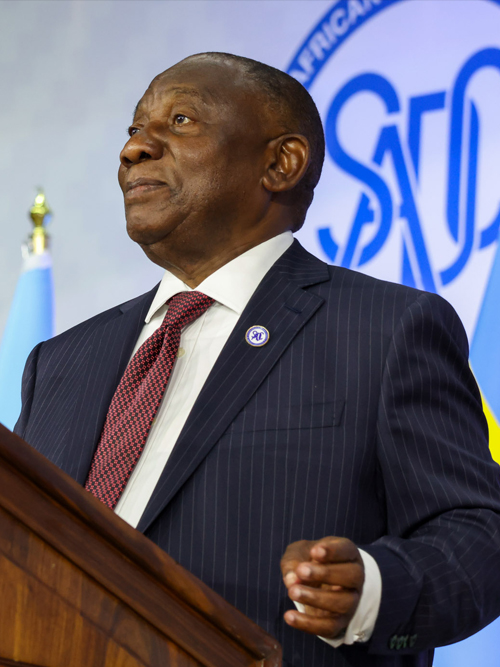
Public Lecture by President Cyril Ramaphosa on the occasion of the 46th SADC Summit, University of KwaZulu-Natal, Westville Campus
Translating SADC Vision 2050 into action: Pathways towards Solidarity, Equality and Shared Prosperity
Programme Director;
Vice-Chancellor and Principal of the University of KwaZulu-Natal, Prof Nana Poku;
Your Excellencies, Ministers and Heads of Mission;
Executive Secretary of SADC, Mr Elias Magosi, and members of the Secretariat;
Premier of KwaZulu-Natal, Mr Thami Ntuli;
Mayor of eThekwini, Mr Cyril Xaba;
Amakhosi and traditional leaders present;
Distinguished academics;
Members of the Diplomatic Corps;
Leaders of business and organised labour;
Representatives of civil society, of women’s formations and of youth movements;
Students of this university;
Fellow Africans;
Sanibonani.
It is a great honour to address you on the eve of a gathering that brings to this city the leadership of our Southern Africa region.
It is fitting that we should gather at a university, because the future of our region will be determined not only in cabinet rooms and summit halls, but also in lecture theatres, laboratories, workshops and centres of innovation.
It is fitting, too, that we should meet here in KwaZulu-Natal.
One hundred and twenty years ago, a young man who was born and raised in these hills stood before an audience at Columbia University in New York to deliver an oration that would resonate across the ages.
In his speech, ‘The Regeneration of Africa’, Pixley ka Isaka Seme presented a vision of a continent freed from the shackles of colonial bondage and alive with human possibility.
It is a vision that has inspired generations of Africans as they strove to overcome the shackles of colonial bondage and to give effect to the promise of liberation.
In words that were both prophetic and moving, Seme said:
“The brighter day is rising upon Africa.
“Already I seem to see her chains dissolved, her desert plains red with harvest, her Abyssinia and her Zululand the seats of science and religion, reflecting the glory of the rising sun from the spires of their churches and universities.
“Her Congo and her Gambia whitened with commerce, her crowded cities sending forth the hum of business, and all her sons employed in advancing the victories of peace – greater and more abiding than the spoils of war…”
This description of a rising Africa lies at the heart of Vision 2050 of the Southern African Development Community.
Vision 2050 imagines a region that is vibrant, dynamic and productive.
It imagines a region where the borders drawn on colonial maps present no hindrance to the free flow of knowledge, capital, goods, services, skills and people.
Vision 2050 imagines a region where all people – from the Cape of Good Hope to the banks of the Congo, from the gleaming shores of Mauritius to the bustling ports of Angola – have food and water, security and comfort.
It is a region whose people live healthy lives, where they are educated, have skills and capabilities, and where they have decent work and sustainable livelihoods.
The formation of SADC was necessary because the brighter future imagined by Pixley ka Isaka Seme could not be achieved by any one Southern African country acting on its own.
Colonialism did not merely conquer our people and occupy our land.
It deliberately fragmented our region.
It divided communities, separated producers from markets and constructed transport systems designed to carry Africa’s raw materials to distant shores rather than to connect African economies to one another.
The economies of Southern Africa were made dependent, unequal and vulnerable.
Many were too small, on their own, to develop competitive industries, mobilise sufficient capital or build the infrastructure necessary for economic transformation.
It was in response to this reality that, in April 1980, the leaders of nine independent Southern African states gathered in Lusaka to establish the Southern African Development Coordination Conference, the organisation from which SADC later emerged.
Their immediate objective was to reduce their economic dependence on apartheid South Africa. But their purpose went much further. They understood that political independence would remain incomplete without economic liberation.
They recognised that the countries of our region shared more than geography. We shared a history, a struggle and a common destiny. Our freedom was interconnected and so too would be our prosperity.
SADC was therefore formed to transform shared vulnerability into shared strength.
It was created so that our countries could coordinate development, connect their infrastructure, expand trade, support liberation and defend the sovereignty of the region.
What began as solidarity in the struggle against colonialism and apartheid has evolved into a project of regional integration and economic transformation.
This is why SADC remains indispensable to the realisation of Vision 2050.
No single country can, on its own, create all the regional value chains we need.
No country can independently build an integrated power pool, develop cross-border transport corridors, manage shared water resources, respond effectively to regional conflict or withstand the full effects of climate change.
But together, we possess the energy, minerals, agricultural resources, skills, markets and financial institutions needed to build a prosperous and industrialised region.
SADC is the instrument through which we can bring these capabilities together.
Its founding represented the conviction that none of us would be truly free until all of us were free.
Vision 2050 now requires us to embrace an equally powerful conviction: that none of our countries can achieve enduring prosperity unless prosperity is shared across the region.
In this sense, Vision 2050 is not a departure from SADC’s founding mission. It is the fulfilment of that mission.
The journey that began with the struggle for political liberation must now be completed through economic integration, industrialisation and the improvement of the lives of all the people of Southern Africa.
The question before us is not whether this vision is attainable. The question is whether we have the courage, discipline and determination to make it real.
The task that falls to all of us – as the Southern African community – is to give life to that vision.
It is up to us to undertake the detailed planning and the painstaking work to build a future that lives up to our people’s expectations.
Vision 2050 must be more than a statement of intent. It must become a programme of action.
It must shape the decisions we take, the budgets we adopt, the infrastructure we build, the skills we develop and the institutions we strengthen.
Above all, it must produce results that can be seen and felt in the lives of our people.
All of us gathered in this hall and all those who live in the hills and valleys, towns and cities that lie across Southern Africa share a common destiny and therefore carry a shared responsibility to achieve Vision 2050.
Among the founders of SADC were nations that, having themselves recently emerged from colonial occupation, were determined that all the people of our region be liberated from oppression and subjugation.
For this principled stance, for their defiance and solidarity, these countries were subjected to years of apartheid aggression, sabotage and destabilisation.
Infrastructure was damaged or destroyed. Citizens were maimed and killed. Development was stifled.
We can never forget that the freedom that South Africans enjoy today was, in great measure, paid for by the people of our region and continent.
We can never forget that this Community was founded as an act of moral solidarity.
As SADC has evolved as an instrument of greater political, social and economic cooperation, the principle of solidarity has remained its driving force.
Since that gathering of visionary leaders in 1980, SADC has been at the forefront of progress in Southern Africa.
It was pivotal in the struggle to end colonialism and apartheid in Southern Africa and to build vibrant democracies that give voice to the needs and aspirations of our people.
Through our Community we have built a free trade area.
We have a Southern African Power Pool through which electricity moves across our borders.
We have one-stop border posts at some of our busiest crossings that have reduced waiting times from days to hours.
We have introduced an electronic certificate of origin that enables a more seamless passage of goods between Member States.
We have an architecture for mediation and for election observation that has reinforced democratic governance and enhanced stability.
While we have made much progress, there is still much to be done.
Trade among SADC states stands at just under a quarter of our combined total trade.
And yet together, we have the means to produce all the goods and services that we need.
Together, as a community, we have all the energy sources we need.
We have the land and the means to produce all the food we need.
Together, we have the mineral resources we need. We have the technology and know-how to turn these resources into the manufactured goods that our people use.
We have the financial institutions, the funding instruments and the markets to finance our industries and to build the infrastructure we need.
And yet we look beyond our shores to supply our people.
Our railways were built to run to the sea rather than to each other.
They were designed to carry raw minerals to destinations far afield and to bring goods produced elsewhere to our cities and towns.
This reliance on others rather than on each other is one of the most persistent constraints to the development of our region.
This weakness is more pronounced at this moment of considerable turbulence in the global economy.
Conflicts that take place far away, in places where most of our people have never set foot, now have a profound effect on their daily lives.
Global shipping is disrupted. Many of our agricultural products cannot reach their markets. Our farmers cannot get fertiliser. The cost of imported grain has risen.
The cost of living is rising with the spikes in the oil price, and some countries are worried about shortages.
The established rules of global trade offer less and less protection, threatening several industries across our region.
These global developments teach us that access to a distant market, however valuable, is a borrowed advantage.
This access may be extended and it may be withdrawn. Decisions are often taken in capitals far away, where our businesses have no say and our workers have no vote.
A regional market is different. A regional market is an advantage that we ourselves own. Others cannot take it away from us.
The welfare of our people and the sovereignty and security of our nations require that we work with greater diligence and purpose to build an integrated Southern African market.
It must be a market in which the value and the benefits of trade are evenly shared.
In doing so, our task is not to reproduce the industrial models pursued on other continents in other times.
Our energy mix is different. Our demographic profile is different.
Our comparative advantage in the minerals of the energy transition is unlike anything possessed by previous rapidly developing economies.
This region holds a substantial share of the world’s critical mineral resources. Many of the materials upon which the energy transition of the entire planet depends lie beneath our soil.
But these minerals continue to cross our borders in raw form. We export the ore and we import the battery.
We supply an industrial revolution taking place somewhere else and we then purchase its products at a price set by others.
We need to use our own resources to drive our own industrial revolution.
Our ambition should not be to catch up with other countries.
Our ambition should be to build a regional economy that is unique to our circumstances and to our time.
To build such an economy, we must firstly complete what we have begun.
We must eliminate non-tariff barriers to trade.
Suppliers should no longer have to wait months for a licence. Goods should no longer have to be inspected on one side of the border and then again on the other. Standards should be harmonised, transparent and applied consistently.
Through the declaration adopted at the 9th SADC Industrialisation Week in this city a fortnight ago, our region has committed to the local processing of both critical minerals and agricultural products.
We must turn that commitment into refining and smelting capacity.
We must turn our intentions into investments – investments in regional electricity generation and transmission, investments in cross-border water schemes.
We must invest in roads, rail lines and ports so that we can move our processed minerals and manufactured goods around our region.
We cannot rely on others to fund these investments. We must do so ourselves.
Through the operationalisation of the SADC Regional Development Fund, we must mobilise the resources needed to drive industrialisation and build infrastructure.
We must use the fund to reduce the cost of capital and more effectively share risk.
At the same time, we must stop the loss of the funds that we already have.
Every year, our continent and our region lose vast sums through illicit financial flows: through transfer mispricing, under-declared exports and smuggling.
We need more than funds. To build these industrial economies requires skills.
We need institutions of learning that build a regional pool of knowledge and expertise to which all Member States contribute and from which all Member States can draw.
We need harmonised laws and regulations that enable greater investment and seamless execution.
The industrialisation of economies will not be founded solely on our natural resource endowment.
Our region has identified pharmaceuticals, automotives, agro-processing, paper and pulp, furniture and, increasingly, the innovation and semiconductor value chains as drivers of industrialisation.
In pharmaceuticals, the case is especially urgent.
We can no longer accept that we import almost everything that heals us.
Our answer must be health sovereignty, pursued in line with the Lusaka Agenda on global health initiatives.
The establishment of a SADC pooled procurement mechanism is a welcome catalyst for accelerated industrialisation in the manufacture of health products.
When we purchase together, we create the market certainty that manufacturers in our region need before they will invest.
That certainty does two things at once.
It secures equitable access to medicines and health commodities for our people.
And it creates jobs, cultivates expertise and stimulates industrial activity here at home.
A region that supplies the world with the minerals of the future should not have to wait upon the world for its medicines.
To realise our region’s potential we need to build integrated infrastructure. We need to develop corridors.
We need to overcome the limitations of geography and history by developing trade and transport routes that bring producers, markets and people closer together.
We need to turn routes like the Maputo, North-South, Trans-Kalahari, Beira and Lobito corridors into living arteries of commerce.
We need to understand that a corridor is much more than a road or a railway line.
It is a new and innovative approach to customs, border protocols, trucking regulations and industrial planning.
These corridors must carry power, data and people.
In energy, we have committed to expediting the interconnectors linking Angola and Namibia, Malawi and Mozambique, Tanzania and Zambia, bringing more of our region into effective power trading through the Southern African Power Pool.
We have committed to universal access to electricity, reaching remote communities through mini-grids and off-grid solutions rather than waiting for national grids that may take decades to arrive.
We have committed to harmonising the regulatory frameworks that allow independent power producers and independent transmission operators to invest with confidence.
And we are diversifying towards utility-scale solar and wind, towards green hydrogen, and towards battery storage.
We must build a Southern Africa that has embraced the potential of digital.
The cost of a telephone call between two SADC countries, the cost of sending money home across a border, the cost of clearing a payment between our banks: these are taxes on integration that we have imposed on ourselves.
That is why we must work together on seamless digital payments and reduced remittance costs.
As we participate in the global digital economy, there is a real danger that we will reproduce the trade patterns of old.
Already, we are exporting data and importing intelligence.
The information generated by our people, our farms, our clinics, our banks and our mines increasingly leaves this region to be analysed, processed and organised elsewhere. This refined data returns to us as a service for which we pay.
The systems that will run our economies are being trained on our data, built on computing capacity we do not own, in buildings we do not host, drawing on electricity we do not sell.
If we are serious about industrialisation, we cannot stop at refineries and smelters.
We need to develop the computing capacity, connectivity and appropriate skills to ensure that the value of our data is extracted here at source.
As we develop new industries, we must revitalise some of our oldest.
Agriculture is our largest employer, and, being susceptible to the vagaries of climate change and global trade disruptions, it is also one of our most vulnerable sectors.
That is why agriculture must become our most modernised sector.
We need modern irrigation, seeds suited to a drying climate, advanced veterinary science and the latest in agro-processing technology, so that value is captured close to the farm and employment is created in the small towns and villages of Southern Africa.
We must build a region of entrepreneurs.
Access to a large regional market is of little use to an enterprise that cannot obtain working capital, cannot meet an export standard and cannot discover who in the next country wishes to buy what it makes.
The development of medium, small and micro enterprises must be treated as core to industrial policy.
Southern Africa’s industrial revolution will ultimately not be driven by the large conglomerates listed on stock exchanges, but by the tens of thousands of small and medium-sized businesses that bring innovation, agility and competitiveness to the economy.
This matters most of all to women and to young people.
Around 40 percent of the people of this region live below the poverty line. Most of these are women and young people.
Many of them rely on the small enterprise for an income.
Yet women who build businesses still meet barriers.
They struggle to own and use productive assets. They are excluded from finance. They cannot reach markets. They are locked out of procurement.
In South Africa, the Women Economic Assembly has been established as a women-led platform to secure procurement opportunities – both public and private – for enterprises owned by women.
Drawing on this experience, we should work to strengthen small enterprises by mobilising a wider range of financing institutions.
We should draw them into regional value chains through a policy environment that opens markets.
Vision 2050 makes the fundamental point that there can be no meaningful regional integration if it leaves out half of our people.
In a region with abundant natural resources, our most precious asset is our people.
Our population is young and growing.
More than half the people of this Community are under the age of 30.
This is our greatest strategic asset. It is the engine of our region’s future.
But a demographic dividend is not conferred by numbers alone.
It is earned through deliberate and sustained investment.
It is earned by enabling young people to work.
Across this region are young people who did everything that was asked of them. They stayed in school. They passed. They borrowed money to study. Many graduated. But now too many young people sit at home with a qualification and no employment.
Youth unemployment is one of the gravest threats to the stability, cohesion and progress of every country in our Community.
And it is one of the foremost obstacles to the realisation of Vision 2050.
If we are to progress, we need to create economic opportunities for the youth.
Our schools, universities, technical and vocational colleges and research institutions are essential instruments through which we enable our people to realise their potential.
But these institutions are only as effective as the foundation on which they build.
It is a foundation that is established in the earliest years of the lives of our youth.
A child whose growth is stunted carries that loss for a lifetime.
No university can adequately undo it.
No industrial policy can properly compensate for it.
Under the Human and Social Capital Development pillar of Vision 2050, we must scale up our investment in maternal health and in early nutrition until stunting has been eradicated from this region.
We must ensure that all children have food, water and shelter, that they are kept safe and that their development needs are met.
We must follow these efforts through into adolescence.
These are the years in which we must invest in the skills of this century, in digital literacy and in health services that a young person can use without fear or shame.
These are the years in which we must confront what stands in a young person’s way: child marriage, teenage pregnancy and a digital divide that leaves young rural people behind.
Each of the barriers we remove adds to the productive capacity of our economies.
Vision 2050 cannot be achieved without a healthy population.
We seek a harmonised regional health system, in which the standard of care a person receives does not depend on which side of a border they happen to live.
Our region still carries far too heavy a burden of maternal, neonatal, child and adolescent death.
Most of these deaths are preventable. This cannot be acceptable.
The withdrawal of official development assistance has exposed how much of our health provision has rested on decisions taken elsewhere.
If we are to achieve health security and sovereignty, we need to realise our commitments under the Abuja Declaration to allocate at least 15 percent of our national budgets to improving our healthcare systems.
The COVID-19 pandemic taught us that no one is safe until everyone is safe.
It taught us that disease does not respect borders.
As a region, we must engage robustly – with one voice – in the reform of the global health architecture.
The people of this region will not reach their potential for as long as division and discrimination remain.
We must break down the barriers of race, religion and tribe.
We must ensure equal opportunity for women and men, for city dwellers and rural folk, for young and old.
Yet there can be no equality between women and men for as long as women are not safe.
Across our region, gender-based violence and femicide wear different faces, but have the same root.
This is a pandemic that has its roots in attitudes, institutions and practices that denigrate and discriminate against women.
Our collective response must focus on prevention, support for survivors, stricter laws, improved prosecutions and the economic empowerment of women.
Our response must be comprehensive.
We must build more sexual offences courts, but we must do much more to address the causes of these crimes.
We must fund prosecution, but we must also fund prevention.
As a Community, we must be clear that prevention does not begin with women.
It begins with the men and the boys in our homes, our schools, our churches, our workplaces and our taverns, who must be raised to reject violence and abuse.
If we are serious about building an integrated region, we must build a Southern Africa in which the equal rights of all people are respected, where all people are treated decently.
We cannot submit to intimidation and harassment of people seen as coming from elsewhere.
As South Africans, we are deeply concerned and ashamed that nationals from other countries have in recent months been subjected to discrimination and ill-treatment.
The criminal actions of a few within our communities are a repudiation of the solidarity upon which this Community was founded.
We cannot preach integration at summits and practise exclusion in our streets.
I say this as a South African, to South Africans, first of all.
But this is a broader challenge to which we must apply ourselves as a Community.
Southern Africa has borne witness to the movement of people over millennia.
Our people are the product of migration.
Migration accounts for much of the diversity, vibrancy and richness of this region.
Now, as we work towards our Vision 2050, we should seek a region in which people are able to freely move according to established principles, protocols and laws.
This means that we must work together to address the conditions that drive migration.
We need to work together to address conflict, instability, governance failure, poverty and social discord.
We need to create equal economic opportunity and build inclusive institutions of governance.
We seek a region where people move out of choice, not out of desperation.
None of what we seek for our region is achievable without peace.
Investment does not flow where there is conflict. People’s basic social needs cannot be provided for in a war zone. An economic corridor cannot operate where territory is contested.
The situation in the eastern Democratic Republic of Congo remains the gravest test of our collective resolve.
Millions of our fellow Africans have been displaced. A country of extraordinary mineral wealth has become a site of conflict and suffering.
Soldiers from our Community were deployed to support efforts to achieve peace and stability. They served with courage and commitment. Some did not return home.
We pay tribute to those who gave their lives for peace.
We owe it to them and their families – and to the people of the DRC – to continue to seek a peaceful resolution to a conflict that has caused such destruction and hardship.
In Mozambique, we welcome the progress of the Inclusive National Dialogue and the signing of the Political Commitment that underpins it.
In Madagascar, our Panel of Elders, under the leadership of former President Joyce Banda, has undertaken several missions in support of a process that must be Malagasy-owned and Malagasy-led.
This Community records its gratitude to her and to our envoys.
Our task is not to prescribe outcomes to the people of any Member State. It is to hold open the space within which they may determine their own.
In support of this principle, we must ensure that our election observation missions are adequately resourced and permitted to report plainly.
We have established institutions of accountability that must be strengthened and must be allowed to do their work.
The achievement of Vision 2050 depends in large measure on the effectiveness of our response to changes in our climate.
Our region has increasingly been struck in successive seasons by drought, by cyclones, by floods.
Our meteorological services warn of a growing El Niño effect in the coming season.
That means reduced harvests, lower exports, pressure on our currencies, a higher cost of living and hunger among our people.
Yet, while we confront drought at one moment, we suffer catastrophic floods at another.
Homes, clinics, bridges, roads and rail lines are swept away.
Lives are lost and livelihoods destroyed.
We all know the destructive effects of a changing climate.
In April 2022, these very hills were struck by floods that took more than four hundred lives, destroyed homes and closed the port on which this region depends.
Resilience must therefore be built into our every endeavour.
We must strengthen the SADC Humanitarian and Emergency Operations Centre so that our response is regional and immediate rather than national and belated.
We must act before a disaster strikes, rather than scramble for assistance after it.
We must develop a common position on loss and damage and speak with one voice in international forums.
Friends,
Let me return, in closing, to the vision of Pixley ka Isaka Seme.
He spoke of chains dissolving. Of arid plains turning red with harvest. Of African cities becoming seats of learning and of science. And he declared that the brighter day was rising upon Africa.
As we gather 120 years later, let us define the meaning of the brighter day we see rising in Southern Africa.
It means a refinery and not only a shaft.
It means a canning plant and not only a farm.
It means electricity generated in one country lighting a home in another.
It means a car assembled in one SADC country using parts manufactured in another using materials produced in yet another.
It means a young woman graduating from this university and building a company that seamlessly trades in all other countries.
It means a child born in any village, town or city within our region having a genuine prospect of the life that her or his talents will merit.
There are many students in this hall today.
The Southern Africa of 2050 we have described will not be run by those of us who will take our seats at the Inkosi Albert Luthuli International Convention Centre in the coming days.
It will be run by you, the youth of our region.
Vision 2050 is not our document. It is yours, and you are entitled to demand an account of what we did with it.
I wish to thank the University of KwaZulu-Natal for hosting this public lecture and for its contribution to the realisation of SADC Vision 2050.
We welcome in particular the four pillars identified by the university: advancing regional value chains in agro-processing and critical minerals, researching ethical AI and digital inclusion, combining indigenous knowledge and innovation systems with climate science for agroecological resilience, and building human capital through youth and women entrepreneurship programmes.
Through policy dialogues and briefs, inter-university research networks and multi-sector consultations, the university has fully embraced its responsibility to contribute to the development, transformation and integration of our region.
One hundred and twenty years ago, the renewal of Africa was a proposition to be defended against a hostile world.
It is no longer a proposition. It is a programme of work. It has actions, assigned responsibilities and deadlines.
The renewal of our continent is achievable.
The realisation of our vision for Southern Africa is within our means.
Let us make good on our commitment to build a peaceful, inclusive, competitive and industrialised Southern Africa.
Let us become a place where all citizens, regardless of place or circumstance, may enjoy sustainable economic well-being, justice and freedom.
Let us go to work.
Merci Beaucoup.
Muito Obrigado.
Asante sana.
Ngiyabonga.
I thank you.
.png)

.png)

